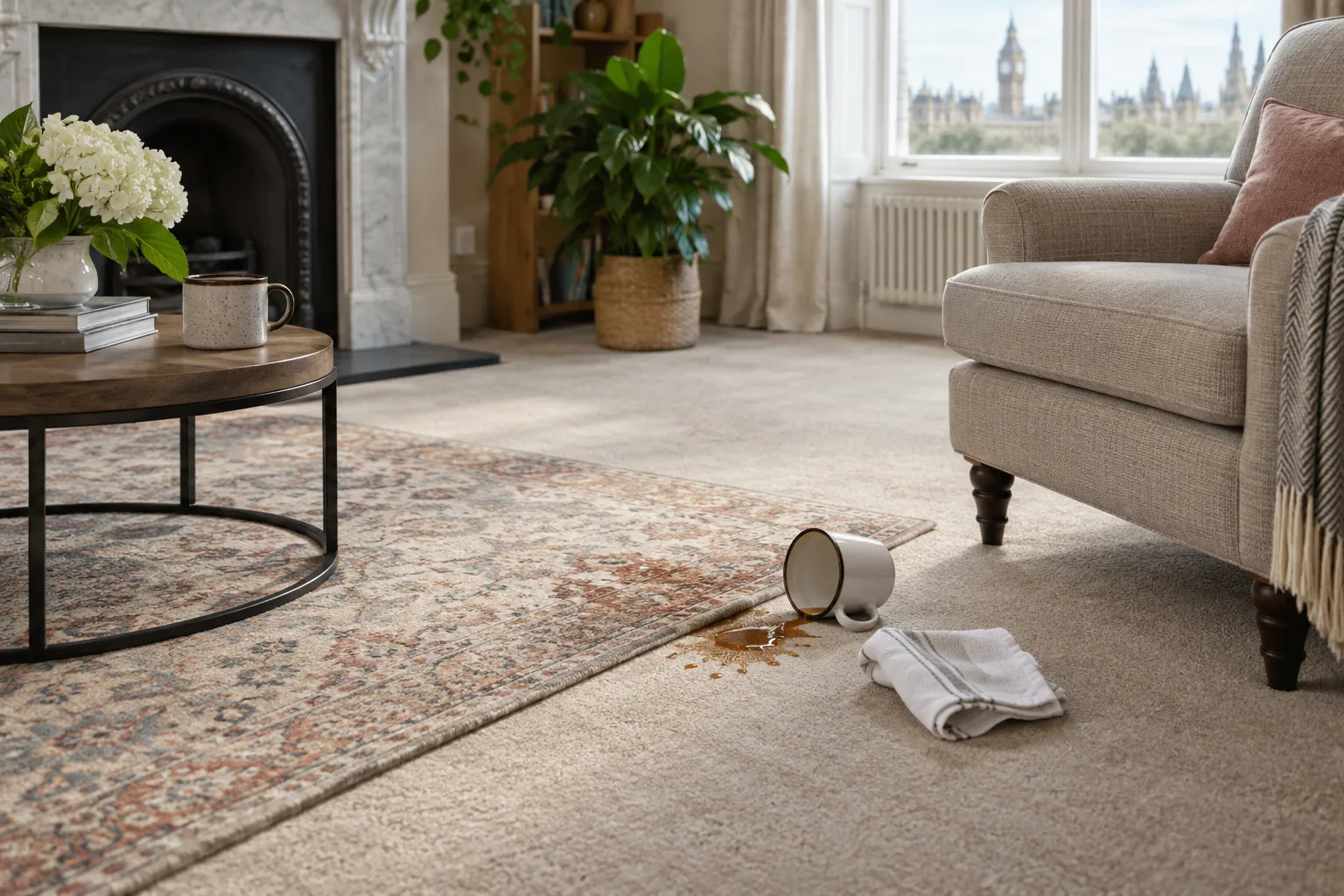
The first response to a spill changes with the surface beneath it. A fitted carpet has a fixed backing and underlay; a rug may have unstable dyes, fringes and a floor underneath; upholstery can carry liquid into foam, feathers or a frame. On all three, remove loose material and blot cautiously, but decide where the liquid can travel before adding anything.
Begin with facts common to every soft surface
Keep people and pets away. Lift solids with a spoon or blunt edge without pressing them into fibres. Use a clean white absorbent cloth to blot liquid from the outside towards the centre. Work with light pressure and change to a dry section as it picks up moisture.
Record the substance, time and any product already used. Do not rub, flood the area or combine household cleaners. Those limits are more reliable than a universal stain recipe.
Fitted carpet: think below the pile
A fitted carpet cannot be carried to a drying area. Liquid can pass through the primary backing into underlay, where it spreads beyond the visible mark. Excessive rinsing may therefore enlarge the affected area even when the surface looks improved.
Check whether furniture legs touch the damp zone and protect them from contact if safe to do so. Avoid pulling up an installed carpet unless a qualified person has advised it; grippers, seams and stretched fitting can be damaged.
Rugs: inspect edges, backing and the floor
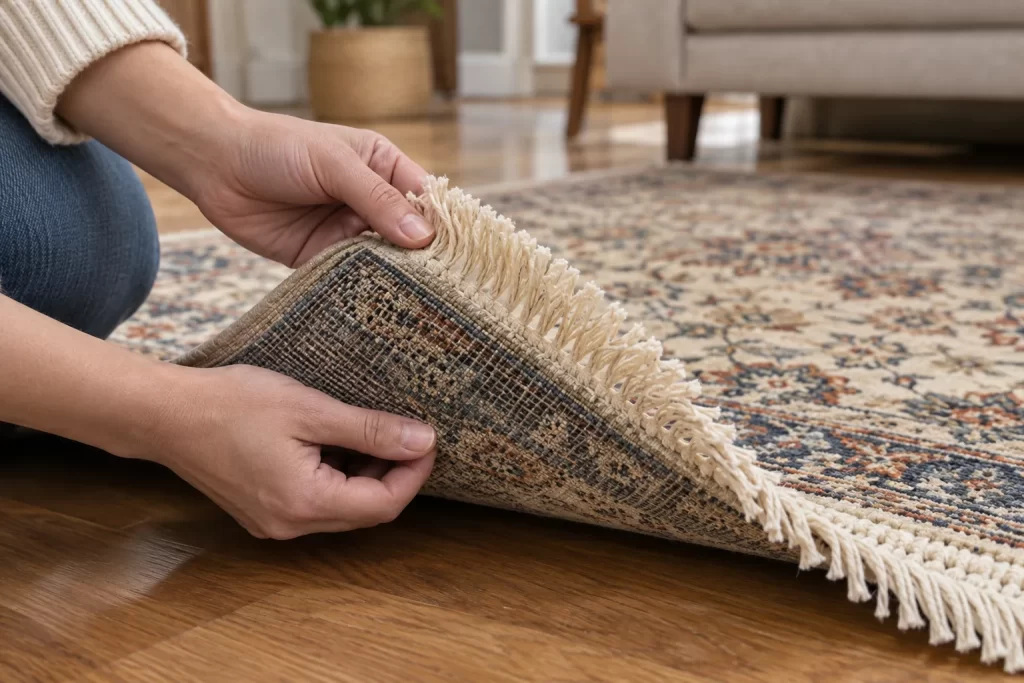
A rug is a separate construction, often with dyes and fibres unlike the fitted floor below. Check the back and the surface underneath without dragging the wet area across the room. Liquid trapped between rug and floor can affect timber finishes, stone sealers or laminate joints.
Fringes and decorative borders may respond differently from the main field. Do not assume that a method tolerated by a synthetic centre is safe for a wool fringe or coloured border.
Upholstery: account for filling and shape
A sofa or chair cover sits over padding and structural components. Pressing hard can drive a spill deeper. Water can also travel along seams and piping, creating a larger outline as it dries. Blot the surface without distorting the cushion.
Do not unzip a cover unless the manufacturer says it is designed to be removed and you understand how it should be handled. A zip may exist for assembly, not domestic washing.
Compare the hidden routes
| Surface | Main hidden route | Early question |
|---|---|---|
| Fitted carpet | Backing and underlay | Is dampness spreading beyond the pile? |
| Rug | Backing and floor below | Are dyes or the underlying finish at risk? |
| Upholstery | Filling, seams and frame | Has liquid entered a cushion or fixed padding? |
The table is a decision aid, not a treatment formula. Fibre, dye, age and previous products still matter.
Labels help, but do not settle the question
A care label may identify fibre or a cleaning code, but it may apply only to the outer cover. It does not confirm colour stability, previous treatment or the condition of fillings. Missing labels call for more caution, not a guessed substitute.
For seating, see the fuller guide to reading a sofa care label. Rugs may have a label on the reverse, while fitted carpet information may remain with purchase documents.
Colour transfer is a universal stop sign
A white cloth makes dye movement visible. If it begins to take on the colour of the carpet, rug or upholstery rather than the spill, stop. Check coloured borders separately because one yarn can be less stable than its neighbour.
Do not try to even out a light patch by wetting a larger area. Dye loss is material change, not soil waiting to be removed.
Odour changes the assessment
Milk, pet accidents and other organic spills can remain below the visible face. Fragrance may mask them temporarily but adds another residue. Note the extent of the odour and whether it increases in warm conditions.
If the substance presents a health risk, contains sharp fragments or is unknown and irritating, isolate it and seek appropriate specialist advice. Standard domestic fabric cleaning does not cover every contamination.
Give each item a safe drying route
For fitted carpet, encourage safe room airflow and prevent foot traffic. For a rug, protect the floor and seek advice before lifting a large wet item that may stretch or transfer dye. For upholstery, space cushions as directed and keep the furniture unused.
Avoid concentrated heaters, hairdryers and plastic covers. Surface dryness does not prove that backing or filling is dry.
When a simple response can continue
Careful blotting remains reasonable when the spill is known, the material is stable, transfer is reducing, the damp edge is not expanding and there is a credible drying plan. Use minimal intervention and reassess after each cloth.
The detailed sequence for a fresh fitted-carpet incident appears in the first ten minutes after a carpet spill. Stop if any warning sign appears rather than repeating the process.
When to request an assessment
- The rug has valuable, handmade or unknown construction.
- Carpet dampness extends into underlay or reaches a seam.
- Upholstery filling is wet or a tide mark is developing.
- Dye transfers, pile changes or the surface becomes stiff.
- The substance is oily, strongly coloured, hot or chemically active.
- Previous home treatment has already been attempted.
Provide photographs of the whole item and the close area, plus labels where available. State honestly what has been applied. A realistic discussion may lead to rug cleaning, carpet work, upholstery treatment or a recommendation not to proceed.
The useful distinction
The safe common action is containment; the difference lies in construction. A rug asks what is happening to its backing and the floor. A carpet asks how far liquid has entered a fixed system. Upholstery asks what the cover is carrying into filling and seams.
Recognising that distinction prevents a familiar mistake: copying a method that seemed successful on one soft surface onto another that only looks similar. Stop early, preserve information and choose the next step for the item in front of you.
Keep a small neutral response kit
Clean white cloths, disposable gloves, a blunt spoon, paper for notes and a phone camera are more useful than a collection of unlabelled chemicals. Store the kit where adults can reach it quickly but children cannot. Replace used cloths so the next spill does not begin with old residue.
The kit supports containment and documentation. It does not make every material suitable for home treatment.
After the incident, update household members on the stop points and where care information is kept. A consistent cautious response is safer than several people applying different products before anyone knows what has already happened.